LangGraph Agent Demo
Explore the interactive LangGraph personalised agent demonstration. See how agents reason and execute tasks with local models.
The University of Queensland
This course explores how modern AI systems represent, align, retrieve, and reason over
high-dimensional multimodal data. Contemporary AI systems, including multimodal foundation models,
retrieval-augmented generation
(RAG), and agents, rely on representing text, images, and other modalities as high-dimensional
embeddings. Understanding how these representations are learned, aligned, indexed, and used for
reasoning is essential for building reliable AI applications.
The course takes a systems view of multimodal AI: from representation learning and alignment to
vector databases and scalable multimodal RAG, followed by efficiency techniques and agent
architectures that enable interactive AI systems. It concludes with frontier applications and
personalization methods such as parameter-efficient fine-tuning.
A central theme is vibe coding: designing AI-assisted systems by reasoning about intent, structure,
and evaluation rather than syntax alone. Through reflective inquiry and a hands-on multimodal
chatbot project, students learn to build, analyze, and critically evaluate modern AI pipelines.
Explore the interactive LangGraph personalised agent demonstration. See how agents reason and execute tasks with local models.
Learn how to build software faster with Coding Agents. A comprehensive guide from first prompts to detailed configurations.
Build an intelligent agent backed by your own multimodal knowledge base. Utilise LangGraph and Large Language Models (LLMs) to produce reliable, grounded, and domain-specific answers.
An interactive web demo that showcases LLaVA (Large Language and Vision Assistant) — a multimodal large language model that can understand both images and natural language instructions. The model runs locally via Ollama, so no API keys or cloud services are required.
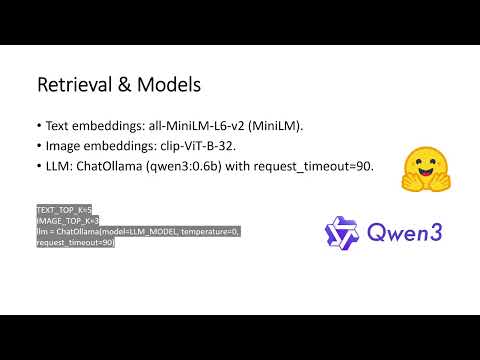
Developed personalised multi-modal RAG agent using curated Pokemon data for the sake of question answering. Explores how hybrid multi-modal retrieval and agentic tool routing impact the response quality compared to simpler, single-modality RAG pipelines and a simple LLM baseline. For the project the curated Pokemon dataset used API data and images using hybrid retrieval to combine text and image search. Includes rule-based agent routing with custom tool and memory. Evaluated using a custom framework to assess question answering metrics.
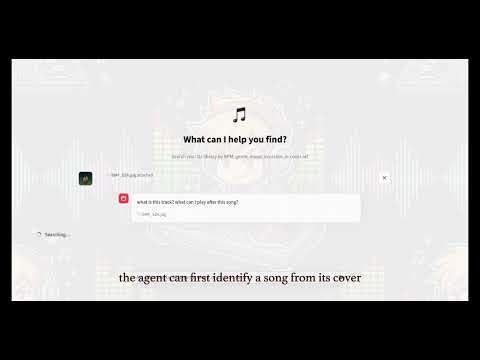
This project presents a multimodal DJ assistant that helps users search personal music libraries, identify tracks from album covers, and recommend compatible next tracks. The system combines Neo4j for structured metadata retrieval, CLIP and ChromaDB for visual cover matching, and a LangGraph agent for multi-step tool use. Transition recommendations are primarily based on BPM proximity and Camelot key compatibility, while semantic metadata helps explain and refine the results. Prompt guardrails and confidence-aware routing reduce hallucination and handle ambiguous cover matches safely.
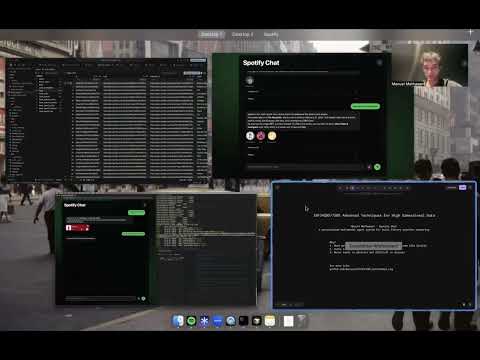
This project presents a personalised multimodal RAG system for question answering related the user's Spotify library. While most multimodal systems focus on images, this work explores audio as a secondary modality by combining relational metadata with audio embeddings generated via LAION CLAP. Utilizing small local LLMs and dynamic agentic routing, the system resolves cross-modal queries regarding the user's listening profile. Evaluation reveals that while this architecture ensures high retrieval precision, it introduces a significant "orchestration tax" on latency. The project highlights the trade-off between complex agentic reasoning and operational efficiency in resource-constrained multimodal systems.
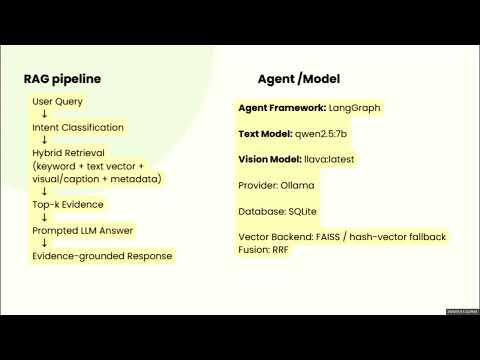
This project presents a Personalised Multimodal Study Agent for INFS4205/7205 course revision. The system indexes lecture PDFs into a persistent SQLite knowledge base, pairing each PDF page with both text evidence and rendered slide images. For each question, it retrieves relevant evidence using hybrid RAG, then generates grounded answers with page references and visual support. It also supports slide search, revision planning, branch follow-up questions, conversation history, and ablation-based evaluation.
Coordinator
Guest Lecturer

Guest Lecturer

Head Teaching Assistant
Teaching Assistant

Teaching Assistant

Teaching Assistant
Teaching Assistant